
How to Search Quitman County Court Records
Quitman County does not publish a single county-run public case search that covers every court file. The official route is office first. Superior Court records, including felony cases, divorce files, civil actions, liens, land transactions, UCC records, plats, jury records, and juvenile-file questions, route to the Clerk of Superior Court. Probate and Magistrate matters, including wills, estates, marriage licenses, guardianship, conservatorship, traffic court, warrant approval, dispossessory cases, returned checks, county ordinance matters, and civil claims up to $15,000, route to Judge L. Matthew Self's Probate and Magistrate Court office.
State systems can supplement that local search. Georgia Courts eAccess is a provider list that redirects users to participating search providers and notes that an account is required. re:SearchGA is a registered-user platform for court case information and documents in participating counties. GSCCCA search is strongest for real estate, lien, plat, UCC, and notary indexes, while GSCCCA eCertification may help when a certified digital document is available from a participating court system.
The GSCCCA Quitman County clerk directory is a useful statewide confirmation source for the local clerk's address, hours, managed courts, and chief deputy.
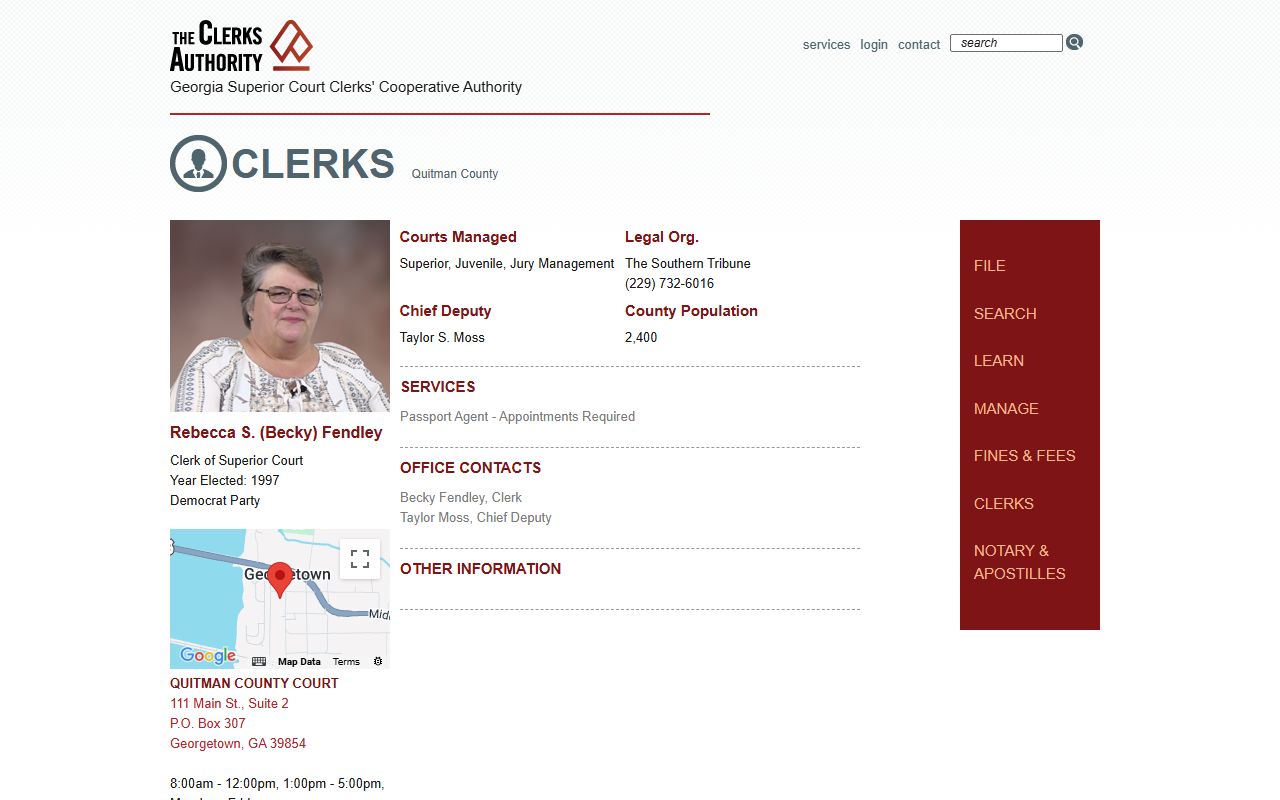
The directory supports the office-first search route because it confirms that the Clerk of Superior Court manages Superior, Juvenile, and Jury Management records.
- Identify the court type before searching. Superior Court points to the Clerk; probate, magistrate, traffic, and warrant matters point to Probate/Magistrate Court.
- Gather party names, case number, filing year, record type, and any citation, warrant, probate, or divorce details.
- Check statewide portals only as a supplement because Quitman County did not appear as a direct public case-search link in the provider rows inspected.
- Call or email the correct local office before visiting when certified copies, older files, or restricted records may be involved.
- Send a written request if the file is not online, and ask for the copy fee, payment method, and delivery options.
| Search Field | How It Helps |
|---|---|
| Court or office | Separates Superior Court files from Probate and Magistrate records. |
| Party name | Use full legal names, aliases, maiden names, or business names. |
| Case number | Best for exact clerk lookup when the local format is known. |
| Filing date or year | Helps staff find older, paper, or legacy files. |
| Copy type | Plain, certified, exemplified, or digital certification if available. |
Quitman County Court System
Georgia does not use a county-level district court structure for Quitman County. The main trial court is the Superior Court, which sits in the Pataula Judicial Circuit with Clay, Early, Miller, Randolph, Seminole, and Terrell counties. The circuit site lists Superior Court Judge Henry L. Balkcom IV with a Georgetown office, and the local Clerk of Superior Court manages the court-record side for Superior, Juvenile, and Jury Management matters.
Lower court work is local but split by function. Probate Court handles wills, estates, marriage licenses, guardianship, conservatorship, weapons carry, and vital-record registrar duties. Magistrate Court handles warrant approval, civil claims up to $15,000, dispossessory cases, returned checks, county ordinance matters, and related first-step criminal processes. Municipal Court may exist where a city operates one, but no separate official Quitman County municipal court page was located. Do not confuse Georgetown-based Quitman County records with the City of Quitman in Brooks County.
The Superior Courts of Georgia Quitman County page is a state-level court source tied to the county's Superior Court identity.
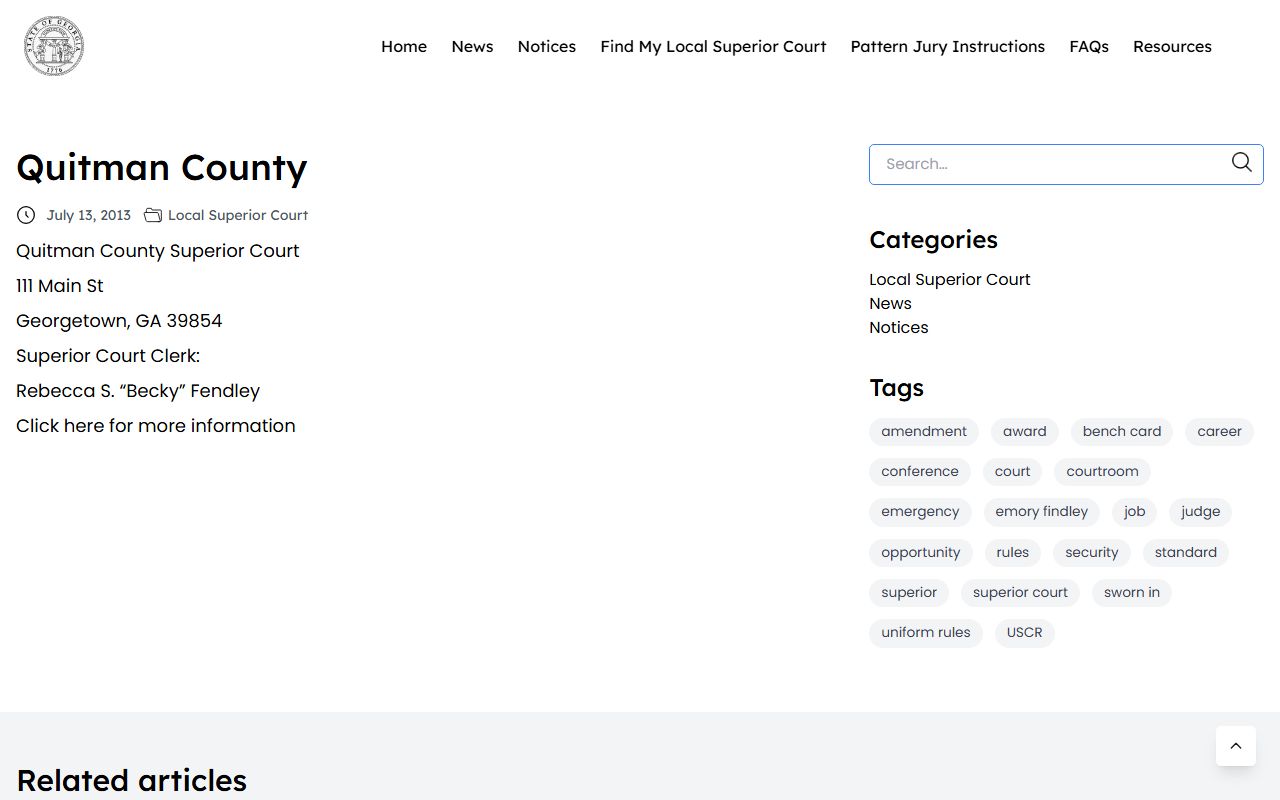
That source helps reinforce why the local trial-court page uses Superior Court terminology even though some users search for a district court.
Case flow: Magistrate or Probate Court activity › Superior Court filing when the case moves there › Court of Appeals of Georgia or Supreme Court of Georgia when an appeal belongs at that level.
| Court or Office | Role | Common Record Types |
|---|---|---|
| Superior Court | General trial court | Felony, divorce, civil, land/title, jury matters |
| Clerk of Superior Court | Record custodian | Civil, criminal, divorce, liens, land, UCC, plats, jury files |
| Probate Court | Probate and vital-record duties | Wills, estates, guardianships, marriage licenses |
| Magistrate Court | Lower civil and warrant court | Warrants, dispossessory, returned checks, civil claims to $15,000 |
| Juvenile Court | Juvenile matters | Delinquency, dependency, child-related files with access limits |
Quitman County Courthouse Contacts
The main court-record address is in Georgetown, the Quitman County seat. The Clerk of Superior Court directory places the office at the courthouse and lists public hours with a lunch closure. Probate and Magistrate Court use a separate local contact path, and Georgia DPH also lists Quitman County Probate Court as a vital-records office at Old School Road. The consolidated government contact page notes that Grove Street is also Old School Road, and Middle Street is also U.S. Highway 82.
Clerk of Superior Court
111 Main St., Suite 2
P.O. Box 307
Georgetown, GA 39854
(229) 334-2578
Probate / Magistrate Court
P.O. Box 7
Georgetown, GA 39854
Judge L. Matthew Self
(229) 334-2224
Consolidated Government
25 Old School Road
P.O. Box 114
Georgetown, GA 39854
(229) 334-0903
The official Clerk of Superior Court page shows the local duties that drive many Quitman County court records searches.
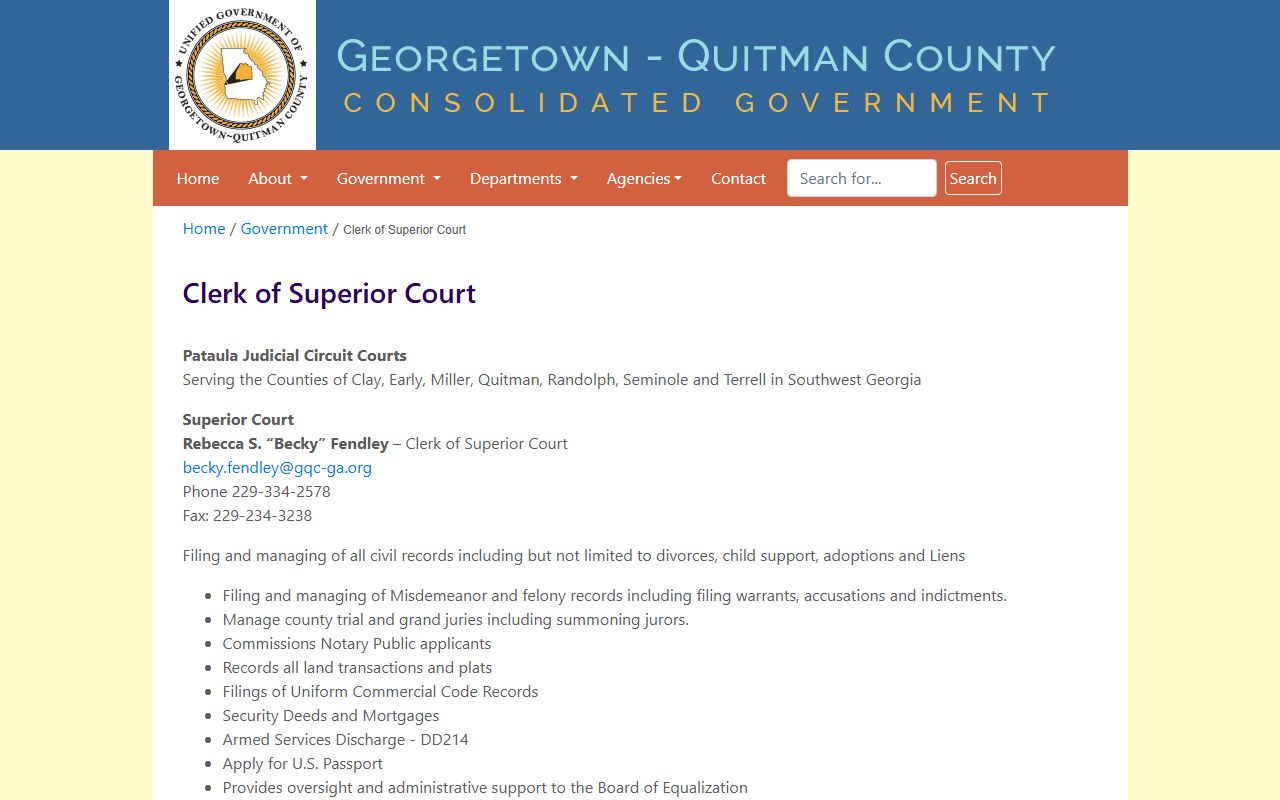
That clerk page is the local source for Superior Court civil and criminal record routing, jury management, land records, UCC records, and passport-agent context.
Quitman County Court Record Types
Quitman County court records are not all held in one file room or one database. A civil Superior Court file may include a complaint, petition, answer, service return, motions, orders, hearing notices, judgment, and post-judgment collection filings. A criminal Superior Court file can include accusations, indictments, pleas, docket entries, orders, verdict, sentence, probation terms, fines, restitution, and final disposition. Divorce is a civil Superior Court record, while marriage licenses and many vital-record functions route through Probate Court.
Probate and Magistrate Court cover a broad local range. Probate files include wills, estate petitions, letters, inventories, guardianship, conservatorship, and discharge orders. Magistrate matters include warrant applications, bad-check warrants, dispossessory cases, returned checks, county ordinance matters, and smaller civil claims. Traffic is listed on the Quitman Probate/Magistrate page and is linked to EZ Court Pay for online fine payment when payment is allowed.
- Civil records: Superior Court complaints, divorces, child support, adoptions, liens, land disputes, and judgments.
- Criminal records: filed charges, accusations, indictments, pleas, motions, dispositions, and sentencing.
- Probate records: wills, estate administration, guardianship, conservatorship, and related orders.
- Traffic records: citation, plea, fine, court disposition, and failure-to-appear action when applicable.
- Land and lien records: deeds, mortgages, plats, UCC records, FiFa entries, and related clerk indexes.
What Quitman County Court Records Show
A Quitman County court file should be read as a chain of events, not just a name result. The docket lists filings and court action in time order. Documents then give the detail behind those entries. In a criminal case, the arrest charge may not match the final accusation, indictment, plea, or sentence. In a civil case, the complaint may state the claim, but later orders and judgments show what the court actually did.
| Field | What It Shows |
|---|---|
| Case number | The local file identifier, if known or assigned by the clerk. |
| Court | Superior Court, Probate Court, Magistrate Court, or another listed court. |
| Parties | Plaintiff and defendant, petitioner and respondent, or State of Georgia and defendant. |
| Docket entries | Filings, service, hearings, continuances, pleas, orders, judgments, and appeals. |
| Disposition | Dismissal, nolle prosequi, guilty plea, conviction, acquittal, judgment, or sentence. |
| Redactions | Protected identifiers, minor names, sealed records, and restricted criminal-history data. |
Quitman County Court Public Access
Georgia's open-records law supports access to public records, but court files also have judicial rules and record-specific limits. The practical local rule is simple: start with the office that keeps the record. A request for a Superior Court divorce decree, felony case, land record, lien, UCC, or civil judgment belongs with the Clerk of Superior Court. A request for a probate estate, marriage license, traffic matter, warrant application, dispossessory case, or small civil claim belongs with Probate/Magistrate Court.
Key Georgia access laws:
O.C.G.A. § 50-18-70 recognizes a strong public-record presumption and narrow construction of exceptions.
O.C.G.A. § 50-18-71 covers inspection and copying procedure for public-record requests.
O.C.G.A. § 50-18-72 lists exceptions, including some pending law-enforcement and confidential medical material.
O.C.G.A. § 35-3-37 governs Georgia criminal-history review, correction, restriction, and sealing.
Restricted Quitman County Records
Some Quitman County court records are public in part, restricted in part, or not open to ordinary public inspection. Juvenile files are managed through the court system but Georgia juvenile-access statutes limit many hearings, records, and files. Adoption records are listed under civil records, yet they are not general public files. Probate mental-health and guardianship records may include private medical or personal details. Criminal-history restriction can limit GCIC access even when local court traces still exist.
Protected identifiers should be redacted from public copies. Those include Social Security numbers, financial account numbers, full dates of birth, minor names, and comparable private data. Pending investigative records may also be limited under Georgia law. If a record is sealed, restricted, or confidential, a written request alone will not open it. Ask the custodian whether party status, a court order, or a specific Georgia procedure is required.
Note: A clerk can confirm the proper request route, but only a judge can authorize access when a court order is required.
Quitman County Sheriff and Jail
The consolidated government sheriff page redirects users to the Georgetown-Quitman County Sheriff's Office website. Official sources reviewed for the research did not publish a Quitman County online jail roster, inmate profile database, or sheriff mobile app. Search snippets identified Charles Junior Davis as Sheriff, but the sheriff website was intermittently unreachable during inspection, so jail and booking questions should be confirmed directly through the sheriff channel or the consolidated government contact path.
For post-arrest case status, the court path matters. Filed criminal cases route to the Clerk of Superior Court, while warrant approval, first appearances, bond-related lower-court records, and traffic matters may involve Probate/Magistrate Court. State-sentenced offenders are searched through the Georgia Department of Corrections, and the GBI sex-offender registry is a separate post-conviction registry, not a jail roster. The full local fallback chain is covered on the Quitman County inmate records page.
The official consolidated government contact page is a fallback source for local office contact information when a direct sheriff or court page is unavailable.
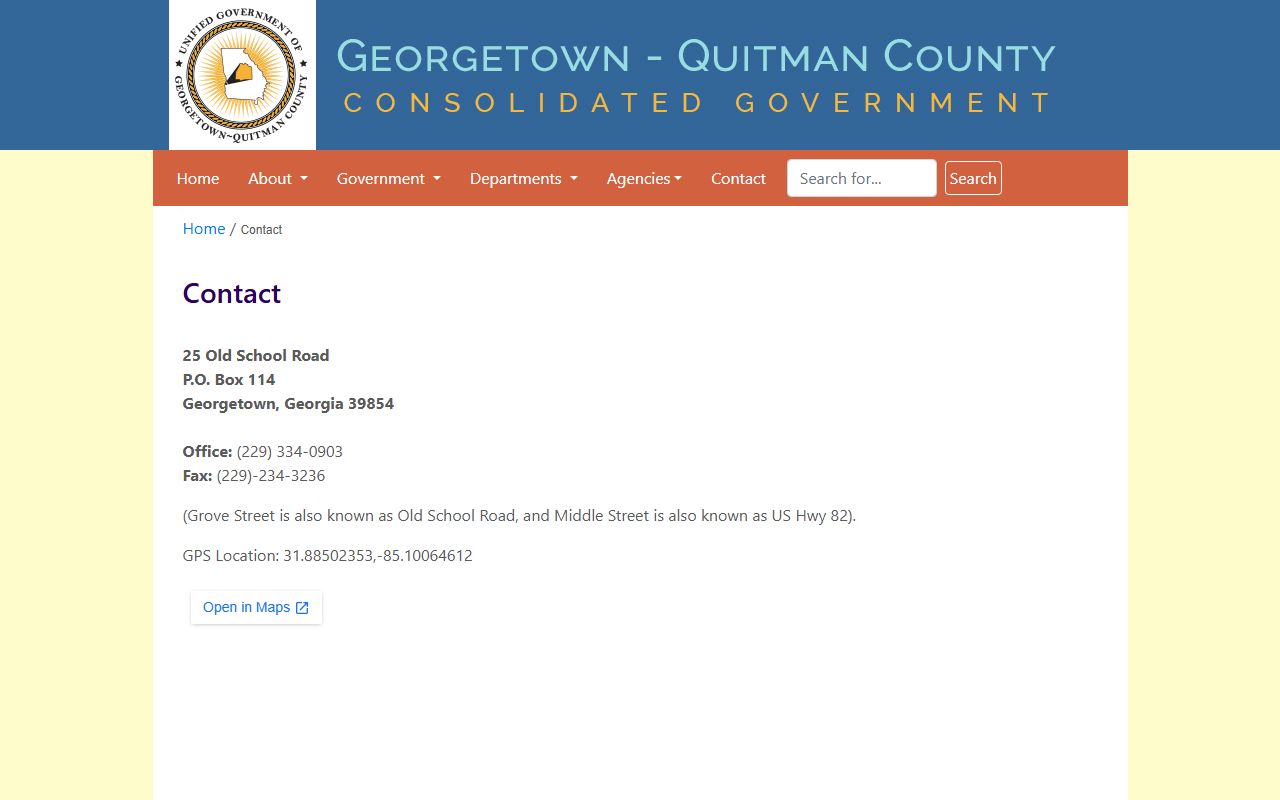
The consolidated government contact page is useful when a direct sheriff or court page is unavailable and a current local phone path is needed.
Quitman County Marriage and Probate
Marriage licenses are handled by Quitman County Probate Court. Georgia allows residents to apply through any Georgia probate court when at least one applicant is a Georgia resident; nonresidents must apply in the county where the ceremony will occur. Both parties must be present, and applicants need proof of age and any divorce proof that applies. The local Probate/Magistrate page did not publish a local marriage-license fee, so applicants should call before visiting.
Divorce records are different. Georgia DPH can confirm certain divorce information, but a divorce decree is held by the Clerk of Superior Court in the county where the divorce was granted. For Quitman County, that means the Clerk of Superior Court in Georgetown. Probate estates, wills, guardianships, conservatorships, and related filings route to Probate Court, with Georgia Probate Court Standard Forms used when local forms are not posted.
The official Probate and Magistrate Court page is the local source for probate, magistrate, traffic, warrant, marriage-license, and vital-record registrar duties.
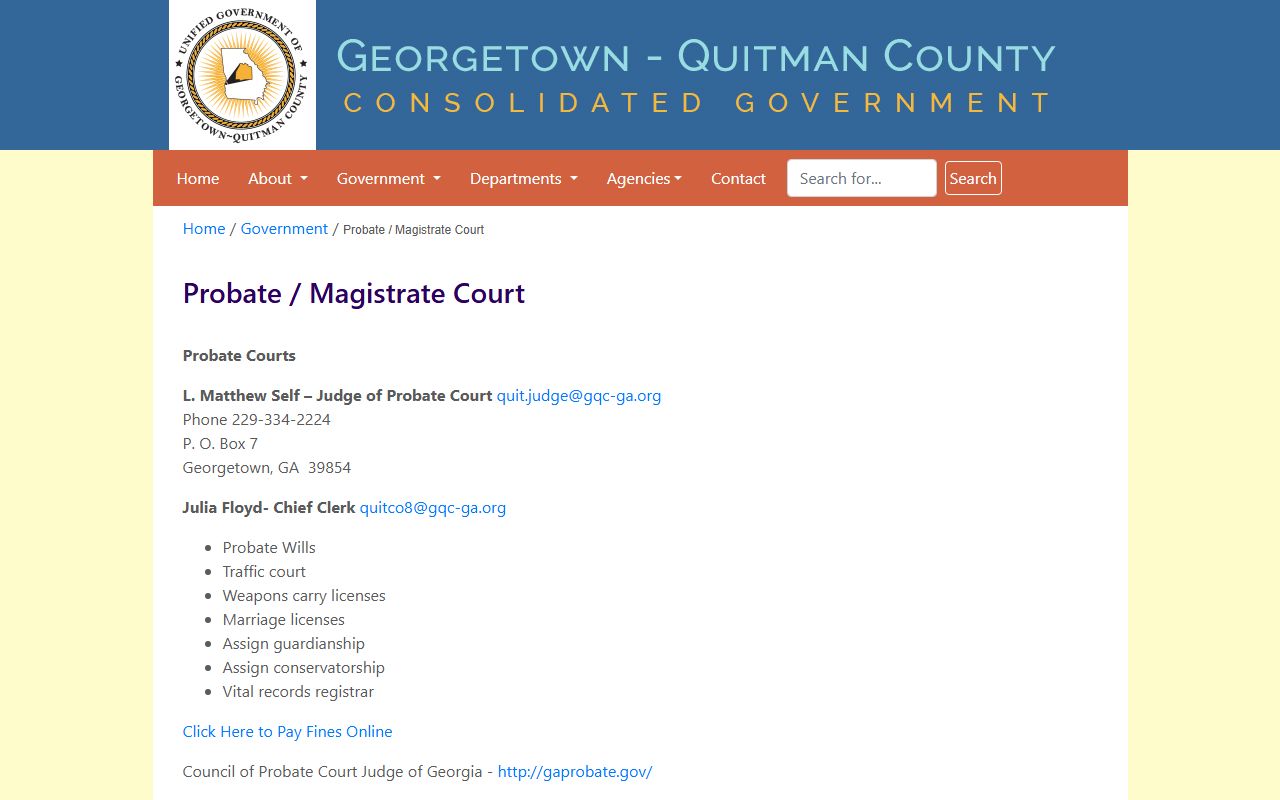
That combined page explains why several record types that might feel unrelated all route to the same Quitman County court office.
- Testator
- A person who made a will.
- Executor
- The person named to administer a will after appointment.
- Conservator
- A person appointed to manage another person's property or finances.
Quitman County Court Record Fees
Quitman County's official research produced a useful Magistrate fee list, but it did not locate a local Superior Court certified-copy fee schedule or a local probate estate fee schedule. That gap should shape requests. Ask the custodian for a cost estimate before asking staff to copy, certify, mail, or retrieve a file. Use published local fees where they exist, and do not assume a statewide amount for a local service that the county has not posted.
| Item | Amount or Note |
|---|---|
| Criminal arrest warrant application | $20.00 |
| Bad-check warrant filing per check | $20.00 |
| Pre-warrant hearing application | $20.00 |
| Civil suits with sheriff's service | $115.00 |
| Dispossessory action with sheriff's service | $101.00 |
| Georgia DPH marriage record | $10.00, additional copies $5.00 |
| Superior Court certified-copy fee | Not located in official Quitman Clerk sources |
Quitman County Traffic Records
Traffic court is listed on the Quitman Probate/Magistrate page, and the page links to EZ Court Pay for online fine payment. Georgia Courts states that Georgia does not have a centralized traffic-citation database. If payment is permitted and the court uses a supported provider, a person may search by name, city or county of issuance, date of birth, or citation information. If a court date was missed, direct court contact is required.
A court traffic record is not the same thing as a Georgia DDS Motor Vehicle Report. The court record shows the citation, charge, plea, fine, disposition, and failure-to-appear activity when applicable. The DDS MVR shows driving history, reported convictions, points, suspensions, license status, and the selected driving-history period. Serious traffic offenses such as DUI can become criminal matters and should be checked through court channels.
Federal Records for Quitman County
Federal court records are separate from Quitman County court records. Quitman County is in the U.S. District Court for the Middle District of Georgia, and the federal qualifying-counties page places the county in the Columbus Division. Federal criminal, civil, bankruptcy, and appellate records are searched through federal systems, not through the county courthouse.
Use PACER for official federal dockets, the Middle District of Georgia for district court information, the U.S. Bankruptcy Court for the Middle District of Georgia for bankruptcy matters, and the Eleventh Circuit for federal appeals. CourtListener can help with research, but it is not the official docket of record.
Quitman County Court History
Quitman County was created from Randolph and Stewart counties on December 10, 1858, and Georgetown is the county seat. The official county history page says a wooden two-story courthouse was built soon after county creation, burned in 1920, and was followed by a rented warehouse used as a temporary courthouse. Revenue limits and the Depression delayed a permanent replacement until federal relief funds supported the current one-story brick courthouse in 1939.
That history matters for record access. A courthouse fire or long-term storage move does not prove that a specific file was lost, but it is a reason to ask the Clerk about older-file survival, indexing, and retrieval. The old Quitman County Jail is also tied to National Register local history, with courthouse and old jail references centered around Main Street in Georgetown.
The official county history page documents the courthouse fire, temporary warehouse, Depression-era funding issue, and 1939 courthouse construction.
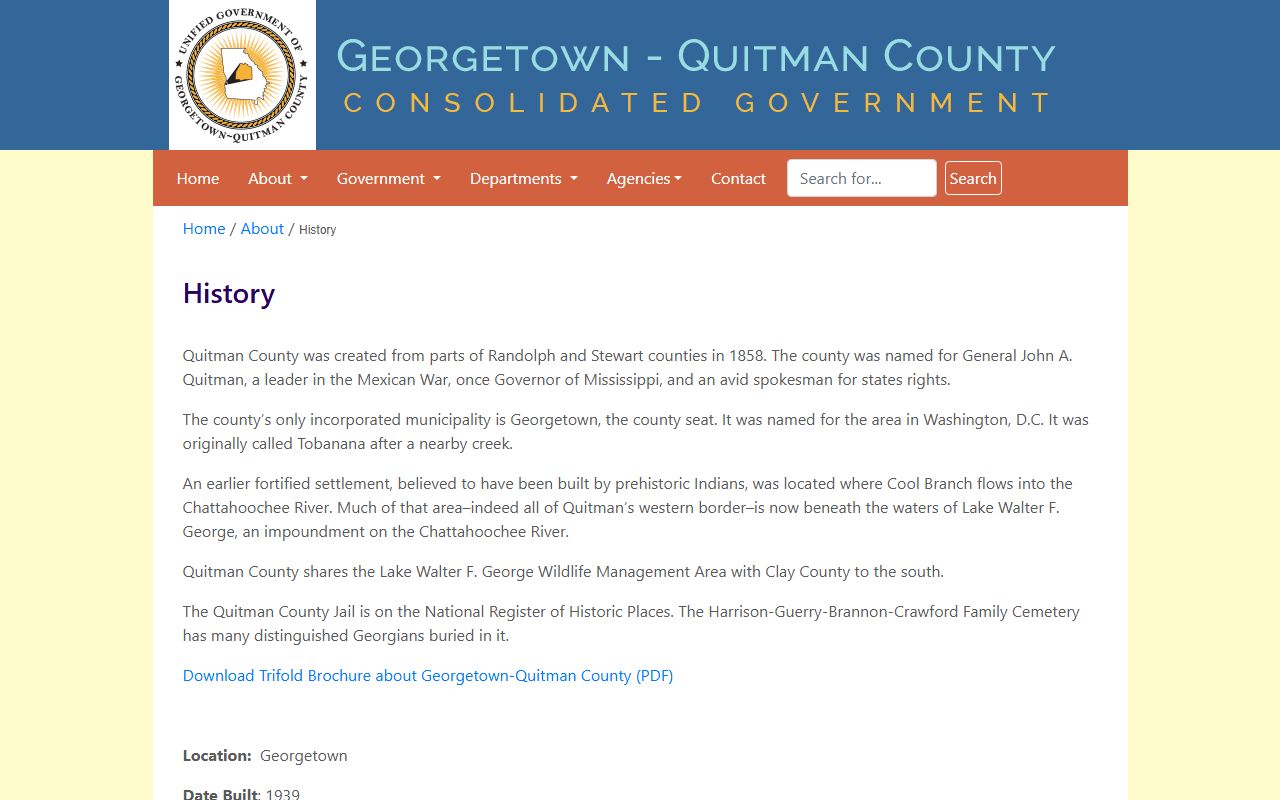
The history source helps explain why older Quitman County court records may require direct clerk review rather than an online search.
Quitman County Court Records FAQ
Is there one online search for all Quitman County court records?
No single official county portal was located for all Quitman County court records. Start with the Clerk of Superior Court for Superior Court files and with Probate/Magistrate Court for probate, traffic, warrants, and lower civil matters. State portals may help with certain indexes or participating-county records.
Where are Quitman County divorce records kept?
Divorce case files and decrees are Superior Court civil records. Georgia DPH may confirm certain divorce information, but decree copies must be requested from the Clerk of Superior Court in the county where the divorce was granted.
Can I search a Quitman County jail roster online?
Official sources reviewed did not publish a Quitman County online jail roster. Use the sheriff's official channel for local custody questions, GDC for state-sentenced offenders, and court offices for filed criminal case status.
Which office handles Quitman County warrants?
Magistrate Court is the key local warrant court because the official page says it approves and signs warrants and lists warrant-application fees. The sheriff handles law-enforcement status and surrender instructions, while the Clerk can help with filed Superior Court cases.