
Quitman County Probate Court Scope
Quitman County Probate Court is combined on the county website with Magistrate Court. The official duty list names probate wills, weapons carry licenses, marriage licenses, assigning guardianship, assigning conservatorship, and vital-record registrar work. The office is led by Judge L. Matthew Self, and Chief Clerk Julia Floyd is listed as the chief clerk contact. That combined page is also important because some lower-court matters, such as warrants, traffic court, county ordinance matters, civil claims, and dispossessory filings, are tied to the same local office.
For probate records, keep the record type clear. Estate papers are not the same as marriage records, weapons carry files, or Magistrate Court claims. A probate estate file can include the will, petition, heirs, consents, notices, letters, oaths, bonds, inventories, asset plans, returns, accountings, and discharge orders. Guardianship and conservatorship files may include sensitive personal, financial, or medical facts. Some records can be inspected or copied, while other portions may be restricted by law or court order.
Quitman County Probate Court Contact
The local contact path is direct because no public probate case-search portal was located for Quitman County. Call or email the court before sending documents or appearing, especially when a filing fee, certified-copy fee, or current counter location matters. Georgia DPH separately lists Quitman County Probate Court as a local vital-record office at 46 Old School Road, which is useful for birth, death, and eligible marriage-record work but should not be treated as the location for every probate filing without confirmation.
The combined Probate/Magistrate setup also means a caller should name the probate function at the start of the call. Estate, guardianship, conservatorship, marriage-license, traffic, warrant, and civil-claim questions can all reach the same general office channel, but they are not the same record set. A precise opening request helps staff route the question to the right file type.
Quitman County Probate / Magistrate Court
Judge: L. Matthew Self
P.O. Box 7
Georgetown, GA 39854
(229) 334-2224
quit.judge@gqc-ga.org
Chief Clerk: Julia Floyd, quitco8@gqc-ga.org
Quitman County Probate Court Vital Records
46 Old School Road
Georgetown, GA 39854
(229) 334-2224
Quitman County Probate Terms
Probate filings use terms that are easy to mix up. The definitions below keep the basic record labels clear before a person selects a Georgia Probate Court Standard Form or asks the local court for a file. A term can affect who may request copies, who must receive notice, and which documents belong in the file.
- Testator
- The person who made a will.
- Executor
- The person named in a will to carry out estate administration after appointment.
- Intestate
- Dying without a will, which can change which heirs and forms are involved.
- Guardianship
- A court arrangement for personal care or decision-making for a minor or adult under Georgia probate practice.
- Conservatorship
- A court arrangement focused on managing property or financial affairs for a protected person.
Georgia Probate Forms for Quitman County
Quitman County's local page does not post individual probate PDFs, so the official form hub is the Supreme Court of Georgia probate standard forms page. It lists Georgia Probate Court Standard Forms for estate administration, wills, guardianships, conservatorships, inventories, asset-management plans, discharge requests, and termination or restoration matters. Use the state form source, then file locally with Quitman County Probate Court after confirming venue, fee, and procedure.
The Supreme Court of Georgia form page is the accurate image match assigned to Quitman County probate records in the manifest.
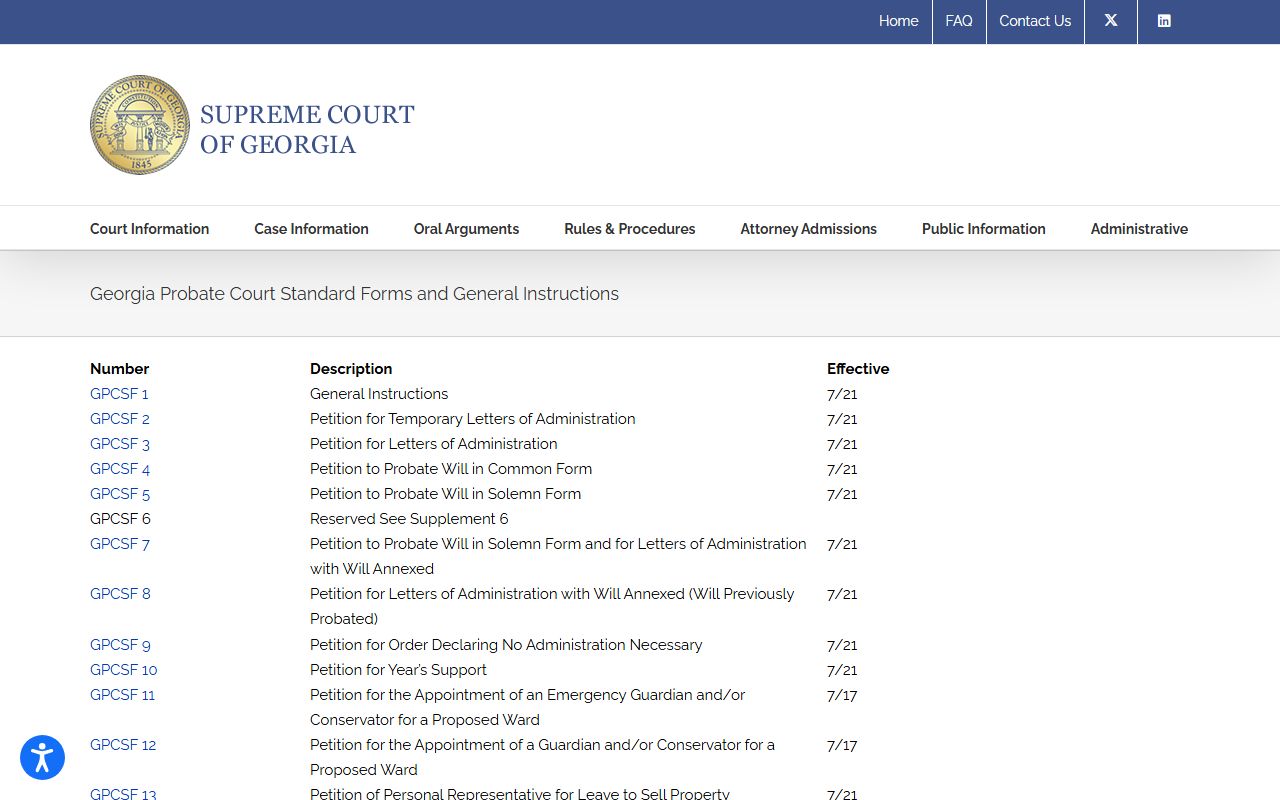
Because the form set is statewide, the local step is confirming that Quitman County is the proper filing court and that the chosen form fits the estate or protective matter.
Examples from the state form list include petitions for temporary letters of administration, letters of administration, probate of will in common form, probate of will in solemn form, no administration necessary, year's support, guardianship and conservatorship petitions, inventory and asset-management plans, petition for discharge, and termination or restoration petitions. Those labels should be used carefully. Selecting the wrong form can send a filer back to the start, because each form is tied to a specific probate request.
Quitman County Probate Record Types
Probate records in Quitman County can cover both estate administration and protective proceedings. Estate files may begin with an original will, a petition for letters, or a no-administration request. Guardianship and conservatorship matters can involve minors or adults. The local court also handles marriage licenses, vital-record registrar duties, and weapons carry licenses, but those are not all open estate files. Request language should state the exact record type, not just "probate record."
- Wills and estate administration files.
- Petitions for letters of administration.
- Petitions to probate a will in common or solemn form.
- Temporary letters of administration and no-administration-necessary petitions.
- Year's support matters when applicable under Georgia probate practice.
- Minor and adult guardianship or conservatorship files.
- Inventories, asset-management plans, returns, accountings, and discharge petitions.
Search Quitman County Probate Records
No public Quitman County probate case-search portal was located in official sources. That means the access path is a request to the probate office, supported by enough detail to identify the file. Older files may require clerk retrieval or in-person inspection. Certified copies should be requested by name, and the request should ask for the current fee and payment method because local copy fees were not published in the official sources reviewed.
Search details should be matched to the kind of file. For an estate, the decedent's full name, date of death, approximate filing year, and representative name are useful. For guardianship or conservatorship, the ward or protected person's name and filing year may be needed, but access may be restricted. For a marriage or vital-record question handled by the same office, applicant names and event dates matter more than estate terms.
- Identify the probate matter: estate, will, guardianship, conservatorship, marriage-license record, or vital-record issue.
- Gather the decedent name, date of death, approximate filing year, estate representative name, and document needed.
- Call Probate Court at (229) 334-2224 or email quit.judge@gqc-ga.org before mailing a request.
- Ask whether the record is public, restricted, sealed, or available only by court order.
- Confirm copy type, certification, fee, payment method, and delivery or pickup options.
Note: Guardianship, conservatorship, and mental-health-related records may contain sensitive details and may not be fully public.
Quitman County Probate Fee Table
Probate fee data is limited in the official Quitman County sources reviewed. The county Probate/Magistrate page publishes Magistrate filing fees, but those are not estate probate filing fees. The research found no local estate probate fee schedule and no local certified probate copy fee schedule. The table keeps those gaps visible so readers do not mail the wrong amount or assume a statewide fee that was not documented for this county.
| Item | Fee | Note |
|---|---|---|
| Probate estate filing fees | Fee not located in official Quitman County sources | Confirm with Probate Court before filing. |
| Certified probate copies | Fee not located in official Quitman County sources | Ask the court for copy and certification cost. |
| Marriage record through DPH | $10; additional copies $5 | Vital-record fee, not estate filing fee. |
| Magistrate civil and warrant fees | Published on local Probate/Magistrate page | Not estate probate fees. |
Quitman County Probate Process
A typical estate process starts with deciding whether there is a will and whether Quitman County is the proper venue. The nominated executor or another interested person then selects the correct Georgia Probate Court Standard Form, files the original will if there is one, provides heir and beneficiary information, and follows notice, oath, bond, letters, inventory, accounting, and discharge steps as required by the type of estate. Some estates will be simpler than others, but the file must still match Georgia probate practice.
Estate flow: Will or no will › Georgia standard form › local filing › notices or consents › appointment and letters › inventory or returns › discharge.
No administration necessary is a specific Georgia probate route, not a universal shortcut. The research notes that Georgia standard forms include a petition for an order declaring no administration necessary under O.C.G.A. section 53-2-40 et seq. when the decedent died intestate and all heirs consent to the agreed division. Confirm that option with Probate Court before treating it as available for a Quitman County estate.
Restrictions should be considered before any copy request. Estate filings often contain property, heir, debt, and representative information, but guardianship and conservatorship files may contain medical, financial, or personal details that are not handled like an ordinary open civil file. Weapons carry license files also have separate public-access limits. A precise request helps the court decide what can be inspected, what can be copied, and what requires a court order.